Network science · Data · 2021
Co-Authorship Network
Mining two decades of DBLP to ask whether collaboration patterns explain a department's rising reputation.
The question
For a network-science course at NTU, two teammates and I turned our own school's faculty into a graph. We pulled every professor's publication history from the DBLP bibliography, drew an edge between any two who had co-authored a paper, and then watched that web evolve year by year from 2000 to 2020. The question underneath it all:
Can network science explain how a department actually collaborates, and even say something about how its research reputation grew?
The real work was building an honest graph
The algorithms were the easy part. The hard part sat upstream, in turning messy bibliographic data into a graph you can trust. We scraped each professor's DBLP page, parsed papers and co-authors into typed records, built the graph in NetworkX, and wrapped it in an interactive Dash explorer so we could scrub through any single year.
The thorniest problem was name disambiguation: two researchers can share a name, and one researcher can appear under three different spellings. There is no clean fix, so we bounded the error instead. We ran the whole pipeline twice, once keying on full names (which over-counts distinct authors) and once on first initials (which under-counts), giving an explicit upper and lower bound on every number we reported.
Collaboration kept compounding
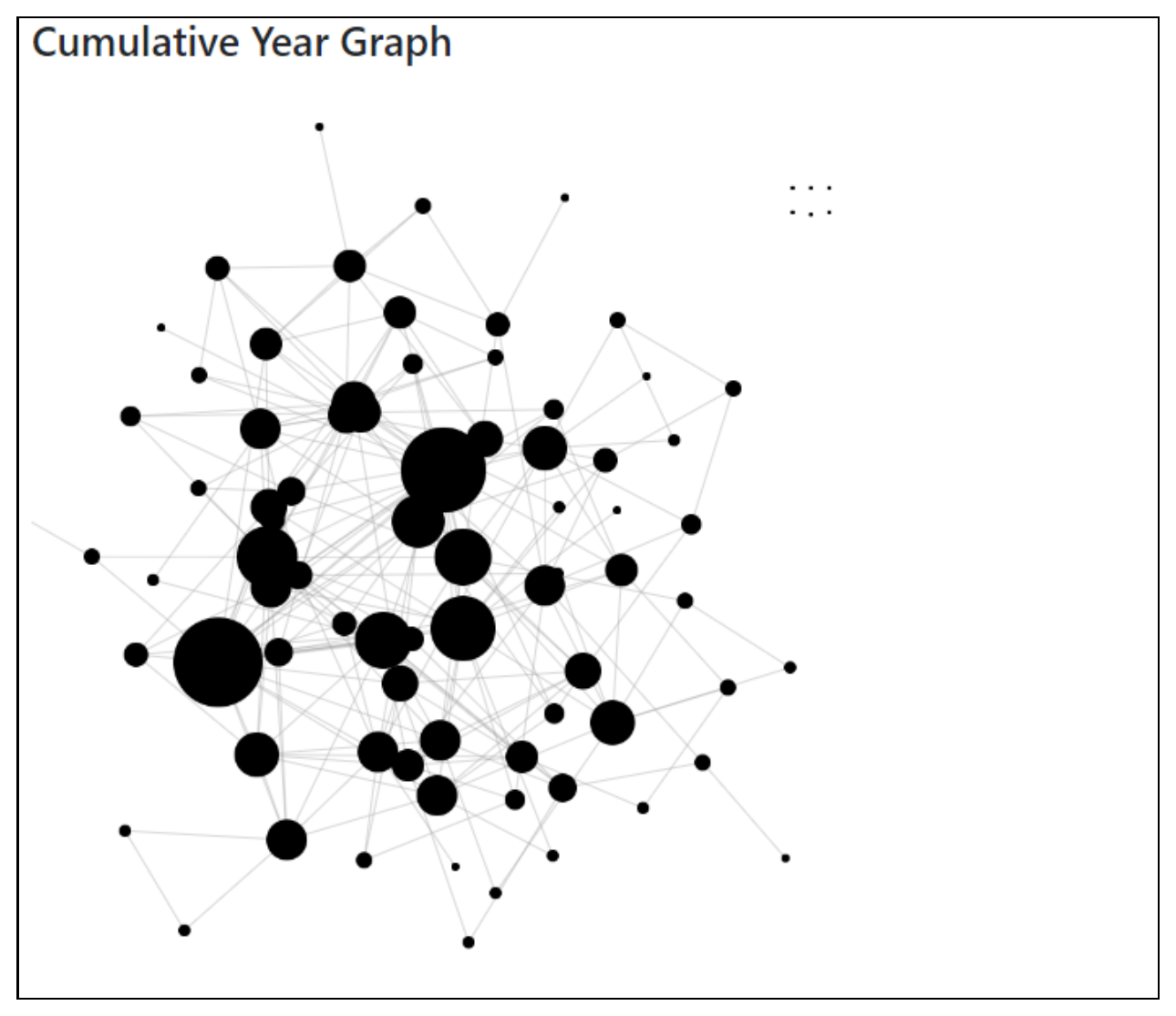
Averaged over five-year windows, the typical faculty member's number of co-authors inside the school climbed steadily from about 13 to 56. By 2020 the network had collapsed into a single giant component: almost 93% of faculty sit in one connected web, and the count of isolated names falls nearly linearly every year. It is also a small-world network, average path length grows like the log of the node count, so any two professors are only a few collaborators apart.
Hubs and bridges are not the same people
Centrality told two different stories about who holds the network together. Degree and eigenvector centrality surface the hubs, the prolific collaborators like Miao Chunyan and Lee Bu Sung. But betweenness centrality surfaces bridges, and they are different people: one professor with fewer collaborators (Luo Jun) scored higher betweenness than a larger hub (Dusit Niyato), because more of the shortest paths between everyone else ran through him. A hub is well-connected; a bridge is structurally load-bearing. Remove a bridge and the graph can split in two; remove a hub and it usually stays whole.
Seniority is written into the wiring
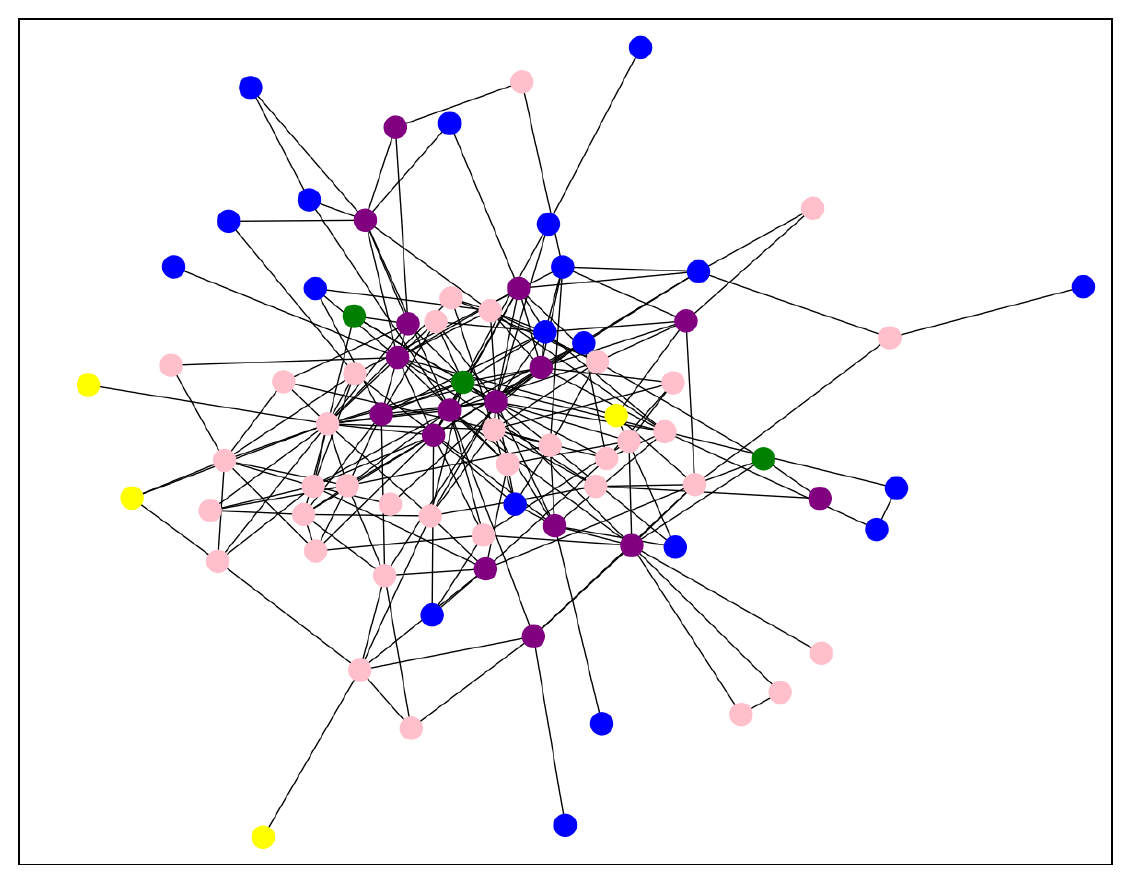
Color the network by academic rank and the hierarchy is visible in the geometry: full professors sit in the dense core, and the ranks fan outward to lecturers on the rim. Average degree tracks seniority almost monotonically, from 9.75 for professors down to 1.5 for lecturers. Most edges run between ranks rather than within them: junior faculty attach to senior hubs. That is preferential attachment, with time spent at the school as the pull. Faculty in management positions behave the same way, a right-shifted degree distribution and higher closeness centrality, classic hub behaviour.
Does collaboration predict prestige?
The tempting hypothesis is that the hubs are the stars. We tested it directly. We defined excellence nodes as faculty with more than ten papers in top venues over a decade, and compared that set to the most central nodes. There is some overlap, but the hubs are mostly not the excellence nodes, and a scatter of top-venue publications against degree gives a correlation of just 0.18. Being central in the collaboration graph and being a top publisher turn out to be nearly independent axes. Structure is not the same thing as prestige.
Turning the graph into a hiring shortlist
The course set an applied twist: if the school wanted to grow, who should it hire? We mined every external researcher who had co-authored with a faculty member since 2017, which left 4,762 candidates. Then we ranked them two ways, by number of excellence papers and by how strongly they already connect into the school, and surfaced the top 150 of each. Two lenses rather than one, so a strong candidate who looks good on only one metric is not quietly dropped.
What I took away, and where it stops
This is still my most-starred repository, and I think that is because it is a worked example of network science on real, messy data rather than a toy graph. The honest caveats are mostly about the data. DBLP does not record when a professor joined the school, so we can only date a node from its first co-authorship, which biases the growth and small-world claims and means we cannot honestly call the network scale-free. Name disambiguation puts a band of uncertainty around every count. The value here was less any single algorithm than building a defensible graph and reading it carefully.
What I took away
- The hard, valuable part of graph analysis is constructing an honest graph from messy real data, not running the algorithms.
- Hubs and bridges are different roles: degree finds the well-connected, betweenness finds the load-bearing.
- Being central in the collaboration network barely predicts publishing in top venues (r = 0.18). Structure is not prestige.
- When you cannot eliminate data error, bound it: running the pipeline two ways gave honest upper and lower limits.